


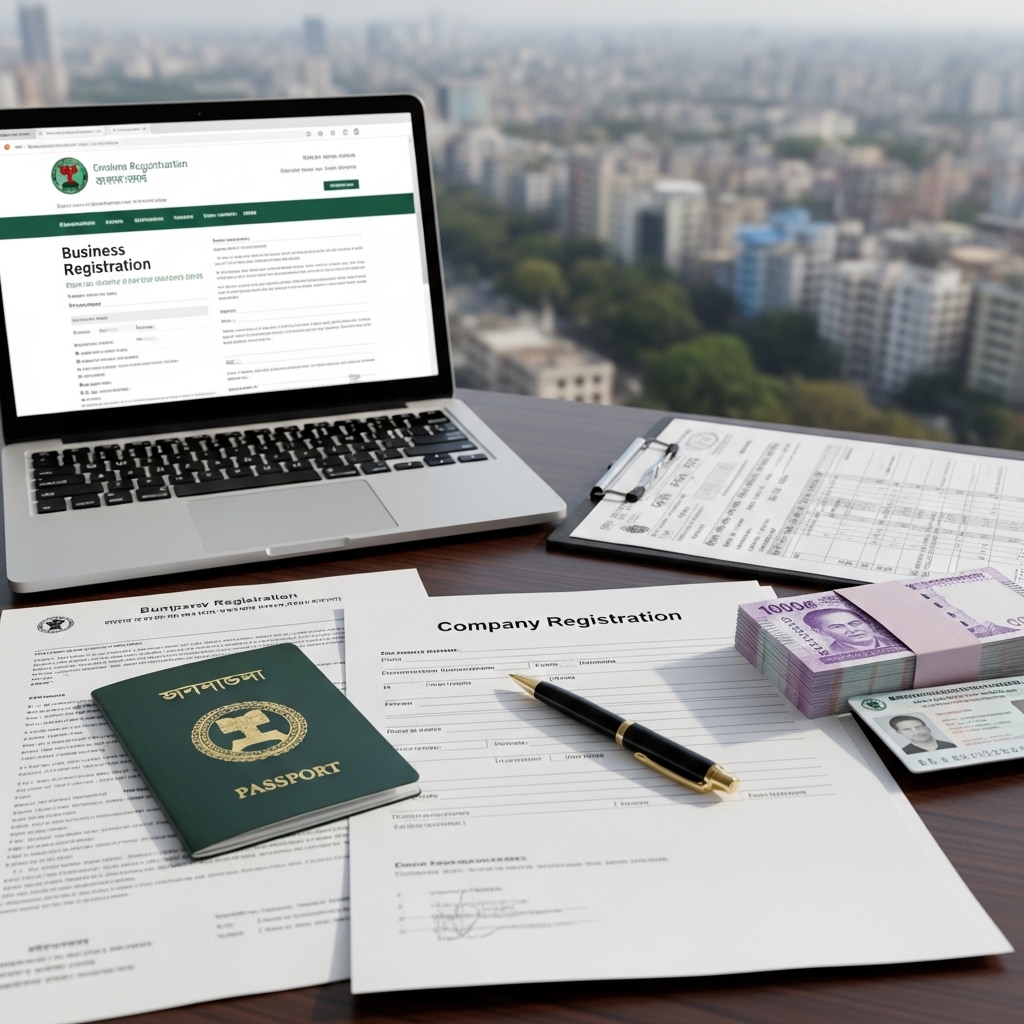
How RJSC filing works
Company incorporation in Bangladesh is completed by the Registrar of Joint Stock Companies and Firms (RJSC), not by the applicant. EOR BD clears the proposed name, drafts the memorandum and articles of association, and lodges the registration set on your behalf.
Where the filing complies, the Registrar registers the memorandum and articles within thirty days of receipt, and where registration is refused the Registrar states the grounds within ten days after that period (Companies Act 1994, s.23). On registration the Registrar certifies that the company is incorporated (Companies Act 1994, s.24).
Name clearance to certificate
The route from a proposed name to a certificate of incorporation is a document chain, and each link is a named record. EOR BD prepares the name clearance application, the memorandum of association, the articles of association, the particulars of directors and the registered office declaration, then lodges them with the Registrar of Joint Stock Companies and Firms. The certificate the Registrar issues is conclusive evidence that the registration requirements of the Act have been met (Companies Act 1994, s.25(1)).
EOR BD files company incorporation in Bangladesh with the Registrar of Joint Stock Companies and Firms. EOR BD clears the proposed name, drafts the memorandum and articles of association, and lodges the registration set. The Companies Act 1994 requires the Registrar to register a compliant memorandum and articles within thirty days of receipt (Companies Act 1994, s.23).
- Name clearance is applied for and held under the proposed company name.
- Memorandum and articles are drafted to your shareholding, not from a template.
- Directors, subscribers and the registered office are recorded as filed particulars.
- Filing is lodged with the Registrar of Joint Stock Companies and Firms in Dhaka.
- Post registration scope covers TIN with the National Board of Revenue.
Which entity route fits you?
The right entity route depends on who owns the business, whether the owner is resident in Bangladesh, and which registry holds the record. EOR BD registers private limited companies, one person companies and partnership firms, and handles branch and liaison office setup for companies incorporated abroad. Each route below states what EOR BD prepares, which registry receives it, and the statutory provision that governs it.
Company registration in Bangladesh is filed with the Registrar of Joint Stock Companies and Firms (RJSC). Foreign investors and overseas owners can use any of these routes, and EOR BD prepares the filing for each.
Limited company
Go from an unregistered trading name to a registered corporate body. EOR BD drafts the memorandum and articles for a private company, whose articles restrict the transfer of shares, prohibit any invitation to the public to subscribe, and cap membership at fifty excluding employees (Companies Act 1994, s.2(1)(q)). The filing is lodged with the Registrar of Joint Stock Companies and Firms.
Name clearance
Go from an unreserved trading name to a name held on the register. EOR BD checks the proposed name against the Registrar of Joint Stock Companies and Firms database, files the clearance application, and holds the cleared name for the incorporation filing. Where a name is rejected, EOR BD prepares the next candidate rather than returning the file to you unresolved.
MoA and AoA
Go from a template constitution to governing documents drafted to your shareholding. EOR BD drafts the memorandum of association setting the objects and share capital, and the articles of association setting share transfer, director appointment and meeting procedure. Both documents are lodged with the Registrar, who registers them where the requirements of the Act are met (Companies Act 1994, s.23).
One person setup
Go from unlimited personal exposure to a registered corporate body held by a single owner. EOR BD prepares the memorandum, articles and nominee particulars for a One Person Company and lodges them with the Registrar of Joint Stock Companies and Firms under the Companies Act 1994. The nominee consent is a filed record, not an internal note.
Partnership firm
Go from an unwritten arrangement to a firm entered on the register. EOR BD drafts the partnership deed covering profit shares, admission, retirement and dissolution, then files the statement of particulars with the Registrar of Firms (Partnership Act 1932, s.58). The Registrar records the statement in the Register of Firms and files it (Partnership Act 1932, s.59).
Foreign branch
Go from an unregistered foreign presence to a recognised establishment in Bangladesh. EOR BD prepares the branch or liaison office application for the Bangladesh Investment Development Authority, sets out the intended activity and remittance basis, then completes the Registrar of Joint Stock Companies and Firms filing and the reporting that Bangladesh Bank requires of a permitted office.
Who carries your filing?
EOR BD is the filing party on your incorporation, and the file stays with one named case owner from name clearance to certificate. That case owner prepares every document lodged, answers every Registrar query, and carries the correction where a filing is returned. You are told which stage the file is at and which document is outstanding, rather than being asked to chase the registry yourself.
Company incorporation in Bangladesh sits under the Companies Act 1994 and is administered by the Registrar of Joint Stock Companies and Firms, an office of the Ministry of Commerce. Partnership firms are registered separately under the Partnership Act 1932. Where the owner is a company incorporated abroad, a branch or liaison office needs permission from the Bangladesh Investment Development Authority before the establishment can operate.
- Escalation path — a Registrar query is answered by the case owner within the same filing, a rejection is escalated to the drafting reviewer who reissues the corrected memorandum or articles under the same name clearance, and a name rejection returns to the clearance stage without restarting the engagement.
- Record retention — every version of the memorandum, the articles, the partnership deed and the particulars of directors is retained on the file, so the lodged text and the approved text can be compared line by line.
- Revenue registration — EOR BD applies for the taxpayer identification number with the National Board of Revenue, and registers the company for value added tax where the turnover test is met or where it supplies goods or services subject to supplementary duty (Value Added Tax and Supplementary Duty Act 2012, s.4).
- Confidentiality — documents are held under a confidentiality undertaking and released only to the named signatories recorded on the file, and Bangladesh Bank reporting for a permitted foreign office is filed by EOR BD rather than by the owner.
Where do RJSC filings stall?
Most delay in a Bangladesh incorporation is not registry speed, it is the filing going back. A name that collides with an existing entry, a memorandum whose objects do not match the intended business, or particulars that disagree between documents all return the file to the applicant. EOR BD removes those four failure points before the set is lodged with the Registrar of Joint Stock Companies and Firms.
-
Direct RJSC submission
-
Drafted to your shareholding
-
Scope boundaries stated
-
Compliance after registration
EOR BD lodges the registration set with the Registrar of Joint Stock Companies and Firms directly, so the file is not passed between a drafting party and a filing party. Where the Registrar is satisfied that the requirements of the Act have been met, the memorandum and articles are registered within thirty days of receipt, and a refusal is communicated with its grounds within ten days after that period (Companies Act 1994, s.23).
Name clearance is applied for and tracked under the proposed company name.
Pre-lodgement check compares particulars across every document in the set.
Registry correspondence is answered by the case owner who prepared the filing.
Status reporting names the current stage and the outstanding document.
Post registration scope covers the TIN application with the tax and statutory compliance team.
A template constitution is the most common reason a memorandum is returned. EOR BD drafts the memorandum of association to the objects you actually intend to carry on, and the articles of association to your share classes, transfer restrictions and director appointment rules. For a private company the articles must restrict share transfer, prohibit public subscription and limit membership to fifty excluding employees (Companies Act 1994, s.2(1)(q)). Each clause is written against that test before the set is lodged.
EOR BD states the boundary of the engagement in writing before the file opens. The scope covers name clearance, drafting the memorandum and articles or the partnership deed, lodging the registration set, answering Registrar queries, and the taxpayer identification number application with the National Board of Revenue. The scope does not cover trade licence issue by the local authority, sector licences, or opening the bank account itself, which the account bank conducts with the signatories directly.
Registration is the start of a company’s filing obligations, not the end. Once the certificate issues, EOR BD hands the company its registered memorandum and articles, the particulars as lodged, and the taxpayer identification number record. Where the turnover test is met, or where the company supplies goods or services subject to supplementary duty, value added tax registration follows (Value Added Tax and Supplementary Duty Act 2012, s.4). Ongoing filing is handled by the EOR BD service teams.
How do the routes compare?
The four registration routes differ on who may own the entity, which register holds the record and which provision governs the filing. Read the row that matches your ownership position first, then the provision column, which names the statute EOR BD files under. Every entry below is drawn from the governing Act rather than from EOR BD practice.
| Route | Ownership condition | Governing provision | Filed with |
|---|---|---|---|
| Private limited company | Members capped at fifty, employees excluded, share transfer restricted | Companies Act 1994, s.2(1)(q) | Registrar of Joint Stock Companies and Firms |
| One Person Company | Single owner with a named nominee on the filing | Companies Act 1994 | Registrar of Joint Stock Companies and Firms |
| Partnership firm | Two or more partners under a written deed | Partnership Act 1932, s.58 | Registrar of Firms |
| Branch or liaison office | Owner is a company incorporated outside Bangladesh | Permission of the Bangladesh Investment Development Authority | Bangladesh Investment Development Authority, then the Registrar |
Statutory filing deadlines
Three deadlines in the incorporation chain are set by statute rather than by EOR BD or by the registry workload. They govern how long the Registrar may hold a compliant filing, how quickly a refusal must be explained, and when value added tax registration becomes compulsory. EOR BD works to these limits and reports the stage your file has reached against them.
| Filing stage | Time allowed by statute | Clock starts at | Provision |
|---|---|---|---|
| Registration of memorandum and articles | Thirty days | Date the Registrar receives the documents | Companies Act 1994, s.23 |
| Communication of grounds for refusal | Ten days | End of the thirty day registration period | Companies Act 1994, s.23 |
| Value added tax registration | From the first day of a month | Turnover crossing the registration threshold | Value Added Tax and Supplementary Duty Act 2012, s.4 |
What happens after your enquiry?
Four stages run between your first message and the certificate of incorporation, and EOR BD names the owner and the outstanding document at each one. No stage is quoted here as a promised duration, because the registry timetable is set by statute and not by EOR BD (Companies Act 1994, s.23). What is fixed is the order of the stages and who carries the file through each of them.
After incorporation a taxpayer identification number (TIN) is obtained from the National Board of Revenue (NBR), and foreign investors may also engage the Bangladesh Investment Development Authority (BIDA) depending on the investment route.
You send details
Send the proposed company name with two alternatives, the owners and their identification documents, and the business objects you intend to carry on. EOR BD confirms in writing which documents are still outstanding, and no drafting starts until that list is closed and the shareholding split is agreed.
We draft papers
EOR BD applies for name clearance with the Registrar of Joint Stock Companies and Firms, then drafts the memorandum and articles, or the partnership deed, to your shareholding. You read and approve the exact text that will be lodged before any document reaches the registry.
We file at RJSC
EOR BD lodges the approved set with the Registrar of Joint Stock Companies and Firms and answers registry queries under the same case owner who prepared the filing. Where registration is refused the file returns with its grounds stated, and the correction is made under the same name clearance.
You receive files
You receive the certificate of incorporation, the registered memorandum and articles, and the particulars of directors exactly as lodged. EOR BD then applies for the taxpayer identification number with the National Board of Revenue and hands over the complete document set for your own records.
Where to read more before filing
Incorporation is one decision inside a wider question about how you will employ and pay people in Bangladesh. The pages below cover the routes that sit either side of a registration, so you can check whether a registered entity is what you need before EOR BD opens a file. Each page is published by EOR BD and kept in step with the same statutes cited on this page.
- Employer of Record in Bangladesh sets out how staff are employed without registering a local entity at all.
- EOR compared with PEO explains which model carries the employment liability and which only administers it.
- Tax and statutory compliance covers the filings a registered company takes on once the certificate issues.
- Payroll management in Bangladesh covers salary processing and withholding once the company begins employing.
- Step by step engagement process describes how EOR BD opens, runs and closes an engagement file.
What do buyers ask?
These five questions are the ones buyers raise before EOR BD opens an incorporation file, and every answer states the position in its first sentence. They cover what EOR BD prepares and lodges, which ownership positions each registration route suits, the documents you must supply before drafting begins, what changes if you deal with the Registrar of Joint Stock Companies and Firms yourself, and where foreign ownership needs a separate permission before the entity can operate.
Do you handle all RJSC paperwork?
Yes. EOR BD prepares and lodges every document in the registration set, and answers Registrar queries directly. The set covers the name clearance application, the memorandum of association, the articles of association, the particulars of directors and subscribers, and the registered office declaration. Where the Registrar is satisfied the requirements of the Act are met, the memorandum and articles are registered within thirty days of receipt (Companies Act 1994, s.23). You approve the text before it is lodged.
Is this right for a small business?
Yes, where the business intends to register as a company or a firm. A private company suits owners who want share transfer restricted and membership capped at fifty excluding employees (Companies Act 1994, s.2(1)(q)); a One Person Company suits a single owner; a partnership firm suits two or more partners working under a written deed. EOR BD sets out which route matches your ownership position before any drafting starts.
What documents do you need from me?
EOR BD needs five categories of document before drafting begins. In order:
- The proposed company name, with two alternatives in case of collision.
- National identity card or passport copies for every director, shareholder or partner.
- The intended business objects, stated in the words you want on the memorandum.
- The registered office address in Bangladesh, with the occupancy basis.
- The shareholding split, and for a One Person Company the nominee and their consent.
Why not file with the RJSC myself?
You can, and for a straightforward single shareholder filing some owners do. The work EOR BD replaces is the drafting judgement: matching the objects clause to the business you actually intend to carry on, writing articles that satisfy the private company test (Companies Act 1994, s.2(1)(q)), and keeping particulars consistent across every document so the set is not returned. Where a filing is refused, the Registrar states the grounds within ten days after the registration period (Companies Act 1994, s.23).
Can a foreigner own a company here?
Yes, and this is also where EOR BD states a limitation. A foreign national or a foreign company may hold shares in a Bangladesh company, but certain activities and any branch or liaison office require permission from the Bangladesh Investment Development Authority before operating, and Bangladesh Bank receives the reporting that follows. EOR BD does not obtain sector regulator approvals outside that permission, and will say so at the scoping stage rather than after a file is opened.
Can a foreign company open a branch office in Bangladesh?
Yes. A company incorporated abroad can establish a branch or liaison office in Bangladesh instead of registering a new local company. EOR BD handles the branch and liaison office route alongside RJSC company registration, and sets out which route fits your ownership structure.
What is the difference between a private limited company and a one person company?
A private limited company under the Companies Act 1994 restricts the transfer of its shares, cannot invite the public to subscribe, and caps membership at fifty excluding employees (s.2(1)(q)). A one person company is registered with a single shareholder. EOR BD drafts the memorandum and articles to match whichever structure your shareholding requires.
What happens after the certificate of incorporation is issued?
The Registrar certifies incorporation on registration (Companies Act 1994, s.24), and that certificate is conclusive evidence that the requirements of registration have been complied with (s.25(1)). A taxpayer identification number (TIN) is then obtained from the National Board of Revenue (NBR), with any further sector or investment registrations arranged from there.
Send your company details for review

