


Quick Answer (Work Permits in Bangladesh)
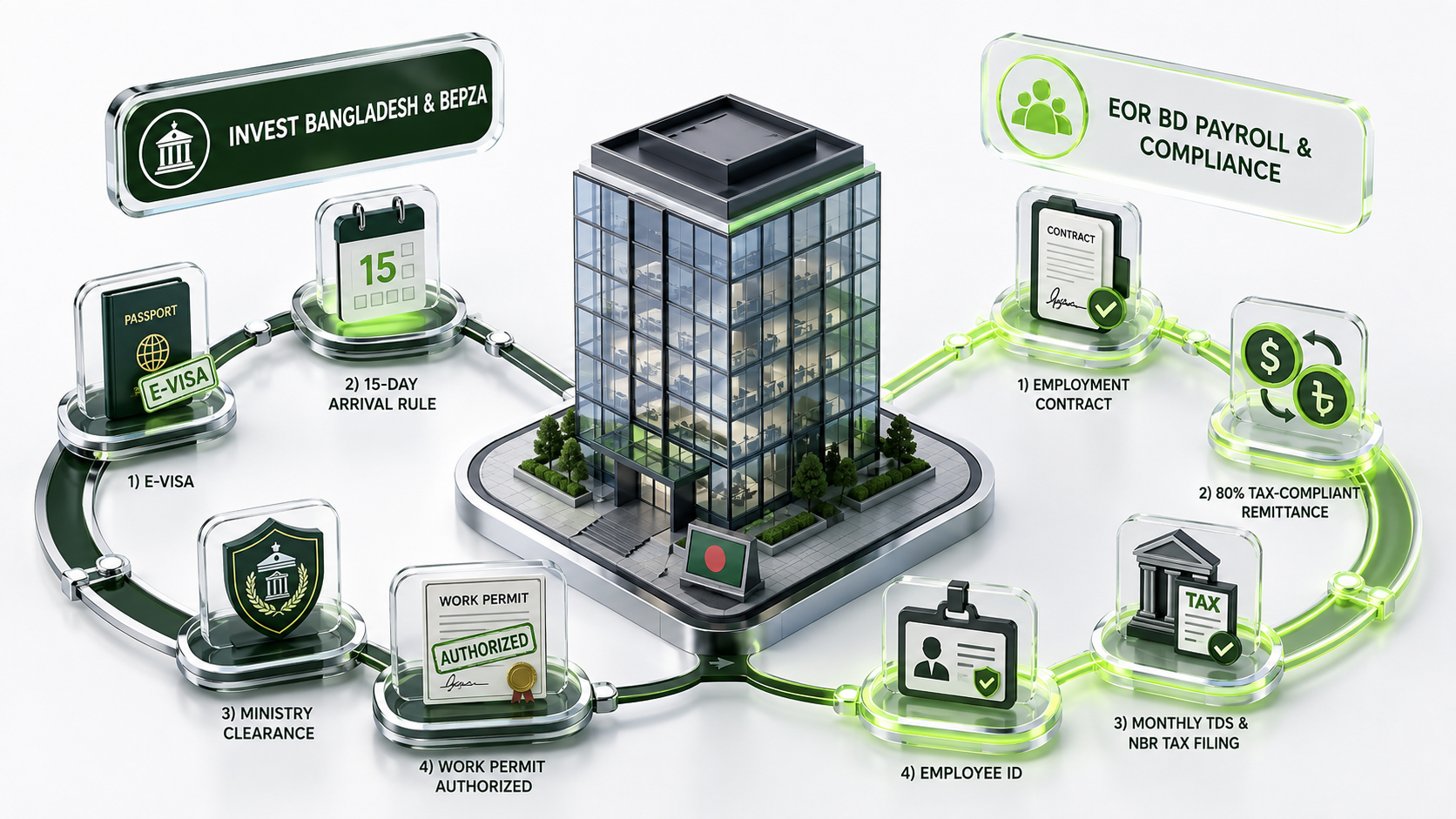
Work permits for foreign employees in Bangladesh are issued by Invest Bangladesh (which merged BIDA, BEZA, PPPA, and BHTPA on 20 August 2026) for general entities, or by BEPZA for export processing zone enterprises. Applications must be filed within 15 days of the foreign national’s arrival in Bangladesh.
Foreign nationals taking up lawful employment in Bangladesh require a statutory work permit issued by the competent government authority, alongside an appropriate employment visa (E or E1 type) and Ministry of Home Affairs security clearance. Sponsoring organizations must hold an eligible Bangladesh registration and satisfy statutory expatriate-to-local employee ratios before onboarding foreign talent.
Post-merger authority routing, full corporate document pack, and renewal calendars.
Key Takeaways for Foreign Employers
- Single Investment Authority: Invest Bangladesh legally unified BIDA, BEZA, PPPA, and BHTPA under Act No. 104 of 2026; BEPZA remains independent for EPZ zones.
- Statutory Permit Fee: Invest Bangladesh charges BDT 5,000 per person per year plus 15% VAT. The BDT 10,000 figure circulating online is a branch office permission renewal fee, not an employee permit fee.
- Strict 15-Day Arrival Clock: The official work permit application must be submitted online within 15 calendar days of the employee landing in Bangladesh.
- Expatriate Quota Ratios: Commercial offices operate under a 5:1 local-to-foreign staffing ratio; industrial projects operate under a 20:1 operational ratio (10:1 during initial setup).
- Unauthorized Worker Penalties: Employing a foreign national without approval triggers a 50% tax penalty or BDT 500,000 (whichever is higher) plus complete disallowance of salary business expenses under the Income Tax Act 2023.
- Employer of Record (EOR) Scope: An Employer of Record in Bangladesh provides a turn-key employment solution for Bangladeshi citizens, but foreign nationals still require a registered sponsoring entity and authority-issued work authorization.
Regulatory Framework: The Invest Bangladesh Act, 2026
Bangladesh fundamentally restructured its foreign investment and commercial regulatory landscape through the Invest Bangladesh Act, 2026 (Act No. 104 of 2026). Enacted by the Jatiya Sangsad and officially gazetted on 20 August 2026, the legislation consolidated four major investment bodies into a single executive agency operating directly under the Prime Minister’s Office:
- Bangladesh Investment Development Authority (BIDA): Abolished & merged.
- Bangladesh Economic Zones Authority (BEZA): Abolished & merged.
- Public Private Partnership Authority (PPPA): Abolished & merged.
- Bangladesh Hi-Tech Park Authority (BHTPA): Abolished & merged.
The Act repealed the BIDA Act 2016, Bangladesh Economic Zones Act 2010, PPP Act 2015, Bangladesh Hi-Tech Park Authority Act, and One Stop Service Act 2018. All records, licensing desks, and regulatory personnel transferred to Invest Bangladesh.
Crucial Exception (BEPZA Not Merged): The Bangladesh Export Processing Zones Authority (BEPZA) remains entirely separate under its governing statute. Enterprises operating inside Export Processing Zones (EPZs) continue filing work permits directly with their respective EPZ zone offices.
Authority Routing and Service Standards Matrix
Selecting the correct issuing authority is dictated entirely by the employing entity’s physical location and corporate registration category in Bangladesh, rather than the foreign worker’s seniority or passport origin.
| Employer Type & Location | Issuing Authority | Statutory Annual Fee | Published Service Standard |
|---|---|---|---|
| Industrial or Joint-Venture Project | Invest Bangladesh (ex-BIDA) | BDT 5,000 + 15% VAT | 3 working days (72 hrs) |
| Branch, Liaison, or Commercial Office | Invest Bangladesh (Commercial Route) | BDT 5,000 + 15% VAT | 16 working days (Committee review) |
| Export Processing Zone (EPZ) Tenant | BEPZA (Autonomous) | BDT 2,500 (excl. VAT) | 7–10 days post-monthly committee |
| Economic Zone (EZ) Enterprise | Invest Bangladesh (ex-BEZA) | BDT 5,000 + 15% VAT | 16 working days (Transition desk) |
| Hi-Tech Park Registered Tenant | Invest Bangladesh (ex-BHTPA) | BDT 5,000 + 15% VAT | In transition |
| Registered Non-Governmental Org (NGO) | NGO Affairs Bureau | Prescribed Bureau Tariff | Subject to Bureau schedule |
Published Statutory Fee Schedule (Debunking the BDT 10,000 Myth)
Invest Bangladesh publishes official tariffs for expatriate personnel services on its investor single-window portal. The official work permit fee is BDT 5,000 per person per year (plus 15% VAT), payable electronically via the One Stop Service (OSS) platform.
Invest Bangladesh Commercial Office Fee Schedule
- E, E1, and PI Visa Recommendation: Free (24-hour service standard).
- New Work Permit (Per Person / Year): BDT 5,000 + 15% VAT (16 working days).
- Work Permit Extension (Per Person / Year): BDT 5,000 + 15% VAT (16 working days).
- Work Permit Amendment: BDT 1,000 (3 working days).
- Work Permit Cancellation: Free (3 working days).
- Branch / Liaison Office New Permission: BDT 25,000 (16 working days).
- Branch / Liaison Office Permission Extension: BDT 10,000 (16 working days).
Why the BDT 10,000 Error Occurs: Several international relocation blogs conflate the corporate Office Permission Extension fee (BDT 10,000) with the individual Employee Work Permit fee (BDT 5,000). Budgeting BDT 10,000 per expatriate needlessly doubles projected statutory payroll line items.
The 15-Day Arrival Filing Rule and Expatriate Staffing Ratios
Managing foreign workforce compliance in Bangladesh hinges on two strict 15-day statutory clocks and mandatory headcount ratios:
1. The Post-Arrival 15-Day Rule
The formal work permit submission must be submitted online within 15 calendar days of the foreign national’s physical entry into Bangladesh. Because the filing requires certified corporate resolutions, local trade licenses, and tax filings, the employer’s document pack must be 100% assembled before the employee boards their flight.
2. The 15-Day Mandatory Recruitment Advertising Window
Where mandatory labor market testing applies, the employer must advertise the open vacancy in national daily newspapers and wait at least 15 days post-publication before submitting the foreign appointment application.
3. Mandatory Headcount Quotas & Training Plans
Bangladesh enforces knowledge-transfer ratios to prioritize local talent development:
- Commercial Offices (Branch/Liaison): 5 local employees to 1 foreign employee (5:1).
- Industrial & Manufacturing Projects: 20 local employees to 1 foreign employee (20:1 operational; 10:1 during initial construction/setup).
Employers must submit a designated list of local employees whom the expatriate is formally assigned to train throughout their tenure.
Real-World End-to-End Timeline & Document Workflow
While published agency service standards specify 3 to 16 working days, real-world onboarding requires 4 to 6 weeks due to external dependencies such as Ministry of Home Affairs security vetting (Special Branch and National Security Intelligence), consular visa processing, and document attestation.
| Stage | Expected Duration | Key Action & Dependency |
|---|---|---|
| 1. Corporate Pack Preparation | 2–4 Weeks | Board resolution, salary structure, and parent apostille. |
| 2. Recruitment Advertisement | 15 Days Minimum | Mandatory statutory job ad publication in national dailies. |
| 3. Visa Recommendation | 24 Hours | Invest Bangladesh OSS e-visa recommendation issued. |
| 4. Consular Visa Issuance | 1–3 Weeks | Bangladesh Mission abroad stamps E-type entry visa. |
| 5. Arrival & Online Filing | Within 15 Days | Submit application dossier via Invest Bangladesh OSS portal. |
| 6. Security Clearance & Permit | 16 Working Days + Parallel | Inter-ministerial committee review and MoHA SB/NSI clearance. |
Tax Obligations, Remittance Rules, and Employer Penalties
Maintaining compliance for foreign personnel requires strict coordination across immigration, tax withholding, and foreign exchange regulations:
Non-Resident Personal Income Tax
Foreign employees classified as non-residents for tax purposes are taxed at a flat rate of 30% on Bangladesh-sourced income without individual slab exemptions. Employers act as withholding agents and must remit Tax Deducted at Source (TDS) monthly to the National Board of Revenue (NBR). For comprehensive withholding models, review our guide on statutory tax and payroll compliance in Bangladesh.
Foreign Exchange Remittance (80/20 Rule)
Under Bangladesh Bank Foreign Exchange Policy Department circulars, authorized dealer banks may remit up to 80% of net earned income after tax abroad during the active employment year. The remaining 20% balance is remittable at the financial year-end upon obtaining a formal tax clearance certificate from the NBR.
Severe Penalties for Non-Compliance
Under Section 265 of the Income Tax Act 2023, employing an unauthorized foreign national exposes the employer to an additional tax penalty equal to 50% of the tax payable on that employee’s income, or BDT 500,000, whichever is higher. Crucially, all salary payments disbursed to unauthorized personnel are disallowed as deductible business expenses.
Does an Employer of Record (EOR) Replace a Work Permit?
An Employer of Record in Bangladesh acts as the legal employer for domestic payroll, employment contracts, and statutory benefits under the Bangladesh Labour Act 2006. Understanding operational boundaries is vital:
- For Bangladeshi Nationals: An EOR provides a complete end-to-end solution. Overseas enterprises can hire local developers, managers, and operational staff in 3–5 business days with 0% entity setup costs.
- For Foreign Nationals Relocating to Bangladesh: An EOR cannot bypass statutory immigration laws. The foreign employee still requires a registered corporate sponsor in Bangladesh (such as an RJSC subsidiary or approved commercial office) to secure authority-issued work authorization. Once authorized, an EOR can manage ongoing payroll, statutory deductions, and HR administration services in Bangladesh.
The EOR BD Four-Layer Readiness Framework
Layer 1 — Entity Readiness: Verify sponsoring corporate eligibility, branch permissions, and investment banding.
Layer 2 — Immigration Readiness: Complete job advertisement testing, obtain Invest Bangladesh visa recommendation, and lodge filing within 15 days.
Layer 3 — Employment Readiness: Structure compliant compensation packages aligned with mandatory salary components in Bangladesh.
Layer 4 — Payroll & HR Readiness: Administer monthly TDS tax deposits, e-TIN filings, and annual NBR tax clearance documentation.
Frequently Asked Questions (FAQs)
How much does a foreign employee work permit cost in Bangladesh?
How long does the work permit approval process take end-to-end?
Can a foreign employer hire in Bangladesh without establishing a local legal entity?
Can an existing work permit be transferred to a new employer in Bangladesh?
What is the maximum validity period for a Bangladesh work permit?
What are the statutory penalties for employing an unauthorized foreign national?
Last reviewed: 1 September 2026 | Reviewed by Bangladesh Corporate & Labor Law Specialists. Sources: Invest Bangladesh Act 2026 (Act No. 104 of 2026), BEPZA Citizen Charter, Bangladesh Bank FEPD Circulars, and National Board of Revenue Income Tax Act 2023.