


Quick Answer: One-Minute Buyer Test
Choosing an Employer of Record (EOR) provider in Bangladesh requires testing operational capability rather than global sales claims: ask each shortlisted provider to price one real role, explain the first monthly payroll cycle, name the exact employing legal entity, and detail the exit terms and data handover process before signing.
Choosing an EOR provider in Bangladesh requires more than comparing monthly fees. A foreign company should verify who will employ its workers, how payroll will run, what the complete cost includes, who will solve employee problems, and how the arrangement can end.
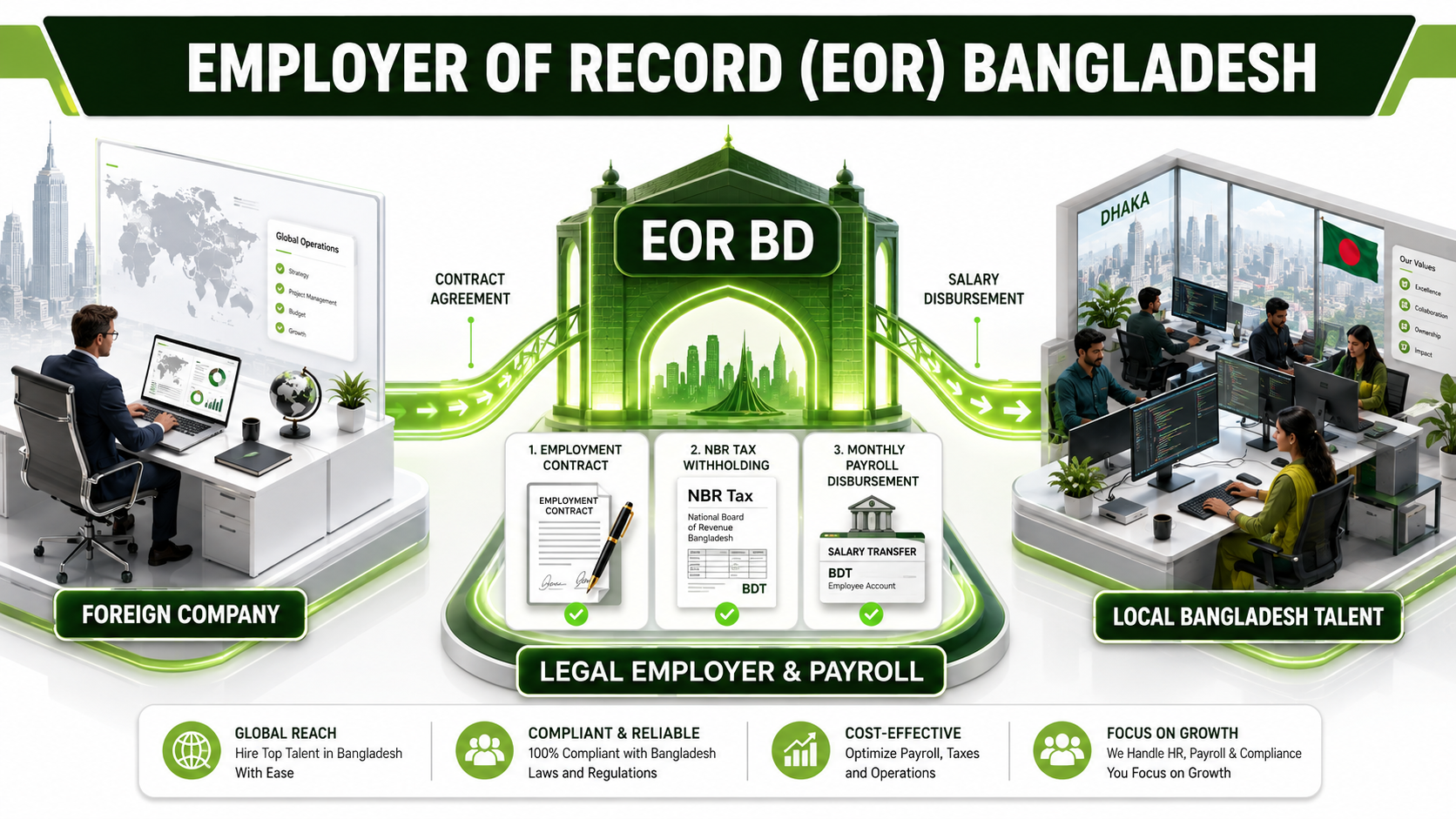
An Employer of Record becomes the local employer while the client company directs the employee’s day-to-day work. Because the EOR touches employment documentation, payroll, statutory benefits, employee support, and offboarding, provider selection affects both the finance team and the people being hired.
Use this guide as a procurement tool. Give every shortlisted provider the same hiring scenario, request the same evidence, and score each answer systematically before choosing an EOR provider in Bangladesh.
Key Takeaways for Buyers
- Operating Model Over Country Count: Compare the provider’s direct Bangladesh infrastructure and local legal presence rather than a marketing claim of 150+ global countries.
- Total-Cost Illustration: Request a complete 12-month cost breakdown based on one actual hire, rather than evaluating an isolated monthly administration fee.
- Pre-Signature Evidence Pack: Review an actual sample Bangladesh employment contract, sample monthly invoice, payroll calendar, and support escalation path before committing.
- Ongoing Problem Resolution: Evaluate how the provider manages mid-cycle salary adjustments, tax documentation, and employee inquiries—not merely initial digital onboarding.
- Controlled Exit Governance: Clarify offboarding charges, employee transition to your own entity, and historic payroll record ownership while you hold negotiating leverage.
- Bangladesh-Specific Documentation: Demand written, local operational commitments over verbal assurances and generic international templates.
What Should a Foreign Company Expect from an EOR in Bangladesh?
A credible Bangladesh EOR must provide a clearly defined employment, statutory compliance, and payroll framework while the client company directs the employee’s daily work and business deliverables. The buyer should know precisely which tasks are included in the recurring service, which management decisions remain with the client, and which specialist services require separate commercial approval.
A practical arrangement connects five core functions: local employment documentation under the Bangladesh Labour Act 2006, employee onboarding, BDT payroll processing, ongoing human resources coordination, and compliant offboarding. For companies scaling remote technical or back-office teams, EOR.BD’s Employer of Record service in Bangladesh coordinates statutory administration, tax withholding, and local labour compliance within a single operating model.
Identify What Is Not Automatically Included
Foreign employers must never assume an entry-level EOR service fee includes recruitment, enterprise equipment provisioning, supplementary private medical coverage, business visa processing, criminal background verification, or custom cross-border tax advisory. Different providers package these modules as billable add-ons, meaning an unchecked assumption can quickly trigger project delays or surprise invoices.
Always insist on a written inclusion-and-exclusion schedule. If a specific operational requirement—such as local laptop delivery or expatriate work authorization—is critical to your roadmap, require its turnaround SLA and pricing formula in writing before signing.
Make the Provider Ask Hard Questions
A competent Bangladesh EOR should interrogate your hiring scenario during discovery: role specifications, work premises, citizenship and residency status, gross versus basic salary construction, target start date, and long-term hiring projections. A vendor that rapidly issues a generic contract without reviewing role-specific parameters is typically optimizing for fast sales velocity rather than operational compliance.
Buyer Checkpoint: Can the provider walk you through the end-to-end employee lifecycle—from signed offer letter to first BDT salary disbursement and statutory final settlement—in clear, practical English without corporate jargon?
The Bangladesh EOR Buyer’s Scorecard: Six Key Evaluation Areas
The buyer’s scorecard translates commercial marketing claims into auditable operational facts. Evaluate every shortlisted partner across these six structured pillars, demanding documentary proof for critical claims and systematically logging unresolved gaps.
Score Evidence, Not Confidence
Apply a disciplined 0-to-5 scoring framework across each dimension:
Calculate category points using the formula: (Score ÷ 5) × Weight. For example, a provider earning a 4 out of 5 in Payroll Reliability achieves 16 out of 20 points.
Remember that a high cumulative score cannot paper over a critical structural defect. An anonymous employing entity, undefined client invoice conversion rates, or restrictive lock-in exit clauses represent immediate disqualifiers regardless of platform UI sophistication.
Buyer Checkpoint: If an independent member of your finance or HR leadership audited the provider’s submission, would their calculated scorecard match yours based solely on written documentation?
Who Will Actually Employ and Support Your Bangladesh Team?
Shortlisted providers must name the exact operating corporate entity that will enter into statutory contracts with your workers. Both wholly-owned local entities and vetted local operating partners can execute compliant arrangements; however, hidden sub-broker chains introduce unmanageable compliance ambiguity and customer support latency.
Audit the Local Delivery Architecture
Submit these precise governance questions in writing:
- What is the registered corporate name and registration number of the entity executing employee contracts?
- Does your organization rely on an external subcontractor or third-party agent for local payroll execution or HR filing?
- Whose corporate name and registered address will appear on statutory payslips and tax withholding challans?
- Who directly receives, reconciles, and processes monthly payroll amendments from the client?
- Whom does the local employee contact when facing personal tax assessment discrepancies or medical benefit claims?
- Who assumes legal accountability if a statutory payroll tax filing is missed or delayed?
A provider with an owned local entity is not automatically superior, and a partner-assisted model is not inherently flawed. The decisive criteria are local regulatory depth, operational responsiveness, and unambiguous contractual accountability.
Test Operational Support Prior to Commitment
Submit an unscripted edge-case scenario during your evaluation:
“An approved performance bonus missed our regular monthly payroll cut-off window. Who directly informs the remote engineer, how quickly can an off-cycle BDT transfer be executed, and what specific administrative fee applies?”
Score the response across four parameters: response speed, technical accuracy, named operational ownership, and fee transparency. Industry forums and payroll practitioner communities frequently identify sluggish ticket-based support, tier-restricted contact access, and detached offshore help desks as top operational pain points.
Buyer Checkpoint: If a banking holiday disrupts monthly salary disbursement, can both your leadership and your local employee contact a named country specialist without navigating an automated ticketing queue?
Total Cost of Employment Matters More Than the Headline EOR Fee
A rigorous Bangladesh EOR cost audit isolates base compensation, employer statutory burdens, recurring management fees, international foreign exchange spreads, and ad-hoc event billing. An aggressive $199 or $299 headline price often masks inflated conversion markups or aggressive exit penalties.
Because compliant compensation in Bangladesh requires managing BDT disbursements, festival bonuses, and National Board of Revenue (NBR) tax deductions, foreign companies should evaluate comprehensive Bangladesh payroll management and disbursement services to understand the true financial baseline.
EOR.BD’s standard published pricing model begins at USD 299 per employee per month, billed separately from salary, statutory items, and optional supplementary coverage. However, buyers should treat every published starting figure as an entry baseline; the binding quote tailored to your headcount and salary level remains the controlling document.
For an exhaustive financial analysis of hidden markups, read our detailed guide to hidden EOR costs in Bangladesh.
Buyer Checkpoint: Can your internal finance controller reconcile the provider’s total invoice from the initial cost sheet without having to ask what an unexplained fee line represents?
What Should You Verify Before Signing the EOR Agreement?
Before executing the Master Services Agreement, verify the underlying contractual clauses governing daily operations: payroll approval cut-offs, pre-funding cycles, error liability, intellectual property assignments, and unilateral termination provisions.
Request a Pre-Flight Evidence Dossier
Require every shortlisted vendor to produce this ten-item verification pack:
- Redacted sample Bangladesh employee appointment letter complying with the Bangladesh Labour Act 2006.
- Complete client Master Services Agreement (MSA) including standard terms and annexures.
- Binding, itemized cost estimate reflecting your specific target salary and headcount.
- Sample regular monthly invoice alongside a variable bonus/adjustment invoice.
- Detailed annual payroll calendar detailing input cut-offs, client approval deadlines, and BDT paydays.
- Two-way client-to-EOR operational responsibility matrix.
- Employee welcome dossier, statutory onboarding forms, and portal login walkthrough.
- Redacted employee payslip and monthly employer tax reconciliation summary.
- Designated account contacts, emergency phone routing, and escalation procedures.
- Documented employee transition protocol, data export guarantee, and entity transfer framework.
When reviewing transition terms, examine our procedural roadmap for switching EOR providers in Bangladesh to ensure that historical payroll archives and tax challans remain your property upon contract termination.
Buyer Checkpoint: If your sales representative departed the company tomorrow, would the executed legal agreements preserve every operational guarantee that influenced your selection?
Red Flags That Should Pause Your EOR Selection
Unclear operating procedures, evasive answers about local licensing, and vague fee structures are not minor administrative quirks—they signal deeper governance and accountability deficits.
Buyer Checkpoint: Do you know the exact commercial cost, legal timeline, and operational process required to exit the agreement before executing it?
Frequently Asked Questions from EOR Buyers
Is formal EOR due diligence necessary when hiring only one employee in Bangladesh?
Can I review a sample employment contract and monthly invoice prior to signing?
Who does an employee contact if a payslip contains an error or salary is delayed?
What happens to payroll and tax records if we decide to switch EOR providers?
Can employees easily transfer to our own Bangladesh entity in the future?
Should we reject an EOR because it utilizes an authorized local delivery partner?
A Better Provider Decision Starts with One Real Scenario
Knowing how to choose an EOR provider in Bangladesh is less about collecting generic sales decks and more about verifying whether a vendor can execute one real-world hiring scenario flawlessly. A trustworthy partner seamlessly aligns the legal employing entity, onboarding workflows, BDT banking disbursement, direct employee support, and exit flexibility into one reliable operational roadmap.
Request an Itemized Bangladesh EOR Cost & Onboarding Plan
Share your role details, expected gross salary, and target start date for a transparent scenario quotation.
Author: EOR.BD Editorial Team | Reviewed by: EOR.BD HR and Payroll Operations Team
Last reviewed: October 13, 2026
Regulatory Notice: This article is published for general managerial and procurement guidance and does not constitute formal legal, taxation, or financial advice. Readers should verify case-specific regulatory requirements with the relevant Bangladesh statutory bodies or qualified legal counsel.