


Key Takeaways for Foreign Employers
- No Entity Required: Foreign companies can legally hire and pay full-time employees in Bangladesh using an Employer of Record (EOR) as the legal employer of record.
- Speed to Market: Onboarding local talent via an EOR takes 48 hours to 7 days, compared to 3 to 6 months for local corporate incorporation.
- Statutory Protection: The EOR handles all employment contracts under the Bangladesh Labour Act 2006, mandatory Festival Bonuses, and National Board of Revenue (NBR) tax deductions.
- Currency & Payroll: Clients remit internationally in USD or EUR, while remote professionals receive monthly net salary in Bangladeshi Taka (BDT) via compliant domestic banking channels.
Expanding your workforce into South Asia offers access to an exceptional pool of skilled software engineers, digital marketing professionals, and back-office operators. However, international companies face a major barrier: Bangladeshi labor laws require a domestic corporate entity to issue employment contracts, process payroll in Bangladeshi Taka (BDT), and withhold statutory taxes.
Setting up a foreign subsidiary through the Registrar of Joint Stock Companies and Firms (RJSC) creates significant administrative friction, capital lock-up, and ongoing corporate tax liability. Fortunately, global enterprises can safely hire employees in Bangladesh without a local entity by leveraging a local Employer of Record services in Bangladesh. This guide breaks down the legal framework, step-by-step hiring process, and compliant cross-border payroll mechanics.
Can Foreign Companies Hire in Bangladesh Without a Local Entity?
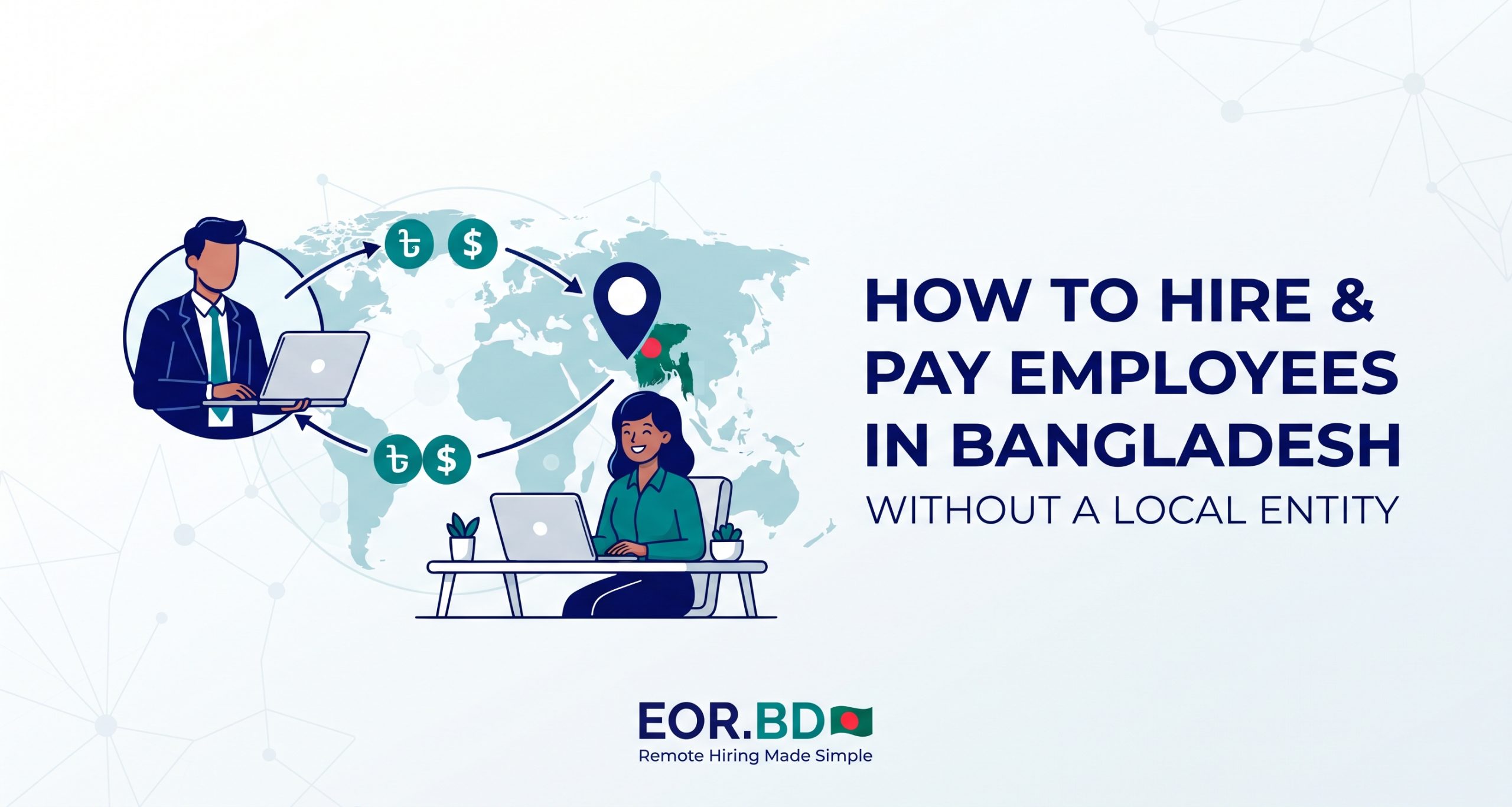
Direct Answer: Yes. Foreign companies can hire and pay Bangladeshi workers without establishing a local subsidiary by partnering with an in-country Employer of Record (EOR). The EOR acts as the legal employer under the Bangladesh Labour Act 2006, handling local contracts, NBR tax withholdings, and BDT salary disbursements while you retain operational control.
Under Bangladeshi corporate jurisprudence, a foreign commercial enterprise cannot directly employ individuals or run local payroll without a registered legal presence. Registering an independent branch office, liaison office, or private limited company requires approvals from the Bangladesh Investment Development Authority (BIDA) and the National Board of Revenue (NBR).
An Employer of Record (EOR) resolves this legal limitation. The EOR already maintains an established, fully licensed Bangladeshi corporate entity with registered tax identification numbers (e-TIN) and statutory bank accounts. By legally co-employing your team, the EOR assumes full civil and statutory liability for local labor compliance, letting you deploy team members immediately.
The Two Pathways: RJSC Incorporation vs. Employer of Record (EOR)
Before entering the market, enterprise leaders evaluate whether to form a local subsidiary or utilize an EOR solution. Understanding the financial and administrative divergence between these two approaches is essential for capital efficiency. For an in-depth financial breakdown and 3-year TCO analysis, explore our complete comparison on EOR vs. entity setup in Bangladesh.
For high-volume manufacturing operations or permanent industrial factories, RJSC company incorporation in Bangladesh remains a viable long-term vehicle. However, for remote software development teams, sales representatives, and back-office operations, the EOR structure provides the ideal balance of legal security and speed.
How to Hire Employees in Bangladesh Step-by-Step via an EOR
Partnering with a professional EOR transforms complex regulatory hurdles into a streamlined administrative workflow. Here is the operational sequence to onboard your remote workforce:
1. Candidate Sourcing and Compensation Agreement
Your team sources, interviews, and selects the desired Bangladeshi candidate. You negotiate the baseline salary in USD, EUR, or BDT. Once terms are established, you provide the job description and compensation specifications to the EOR provider.
2. Locally Compliant Employment Contract Execution
Under Section 5 of the Bangladesh Labour Act 2006, every employee must receive a formal written Appointment Letter and Identity Card. The EOR drafts a dual-language, statutory employment contract containing job classification, working hours (standard 48 hours per week), probation periods, and termination provisions.
3. KYC Onboarding, National ID, and e-TIN Registration
During the onboarding window, the EOR collects mandatory Know-Your-Customer (KYC) documentation, including the National Identity Card (NID), academic credentials, and electronic Tax Identification Number (e-TIN). The worker is formally registered with local authorities in 2 to 7 business days.
4. Monthly BDT Payroll Processing & Tax Withholding
Each payroll cycle, you receive a consolidated international invoice covering gross salaries, statutory contributions, and management fees. The EOR calculates progressive income tax deductions, remits payments directly to the National Board of Revenue (NBR), and credits net compensation to the employee’s local bank account.
To examine the complete operational timeline from initial screening to first pay slip, review our verified guide on how to hire employees in Bangladesh step-by-step.
How Foreign Companies Pay Remote Employees in Bangladesh Compliantly
Paying remote talent across international borders involves foreign exchange governance and domestic taxation rules enforced by the Bangladesh Bank and the National Board of Revenue.
1. Cross-Border Currency Invoicing
Directly transferring funds via generic peer-to-peer money apps or informal channels creates severe tax evasion risks and banking freezes for local workers. With an EOR, the foreign enterprise transfers funds in foreign currency (USD, GBP, or EUR) through standard SWIFT corporate wire transfers. The EOR converts the funds at official interbank rates and deposits BDT directly via local clearing networks (BEFTN/NPSB/RTGS).
2. NBR Income Tax Slabs & Withholding at Source
Under the Income Tax Act 2023, employers are strictly required to deduct income tax at source (TDS) from monthly salary disbursements. Personal income tax rates in Bangladesh range from 0% (tax-free threshold) up to 25% across progressive income slabs. The EOR calculates exact monthly deductions, files statutory withholding returns, and issues annual Tax Deduction Certificates to workers.
Review the latest tax slabs and statutory filing schedules in our detailed breakdown of Bangladesh payroll tax compliance.
3. Mandatory Statutory Employee Benefits
To remain 100% compliant with Bangladeshi employment regulations, foreign employers must ensure their compensation structure includes mandatory statutory entitlements:
- Festival Bonuses: Employees who have completed at least one year of continuous service are entitled to two mandatory festival bonuses each year, typically equivalent to basic monthly salary.
- Annual Leave (Earned Leave): Permanent workers accrue one day of earned leave for every 18 days worked, along with standard statutory public holidays and casual leave.
- Provident Fund / Gratuity: Depending on company policy and statutory thresholds, long-term employment benefits such as Provident Funds or Gratuity settlements apply upon separation.
Risk Assessment: Direct Contractor Engagement vs. EOR Co-Employment
Many foreign organizations mistakenly classify full-time remote staff as independent contractors. In Bangladesh, labor inspectors examine the actual nature of the working relationship rather than contract titles alone.
Direct Contractor Model (High Risk)
- Misclassification Penalties: Risk of back-taxes, unpaid bonus liabilities, and fines from the Labour Court.
- IP Ownership Vulnerability: Freelance agreements without local jurisdiction clauses fail to protect core intellectual property.
- Banking Scrutiny: Contractor foreign remittances often trigger regulatory reviews at Bangladesh Bank.
EOR Co-Employment Model (Protected)
- Complete Legal Shield: EOR BD acts as the statutory employer, absorbing all civil and labor compliance risk.
- Enforceable IP Assignment: Contracts include robust local non-disclosure and intellectual property assignment covenants.
- Clean Tax Clearances: Employees receive legitimate payslips and official annual NBR tax certificates.
Frequently Asked Questions (FAQ)
? How does an EOR work in Bangladesh?
An Employer of Record (EOR) serves as the registered legal employer for your local team members in Bangladesh. The EOR issues locally compliant contracts under the Bangladesh Labour Act 2006, administers monthly BDT payroll, withholds NBR income taxes, and manages statutory employee benefits while you direct their day-to-day work.
? What is the typical cost of hiring through an EOR in Bangladesh?
Specialized in-country providers like EOR BD offer transparent pricing starting from $299 per employee per month, with zero setup fees. This represents significant savings over global aggregator platforms that charge $599+ monthly for the same local infrastructure.
? How quickly can I onboard a full-time employee in Bangladesh?
Once you have selected your candidate and agreed on compensation, an EOR can finalize contracts, complete national identity verification, and prepare the worker for active payroll within 5 to 7 business days.
? Can foreign employers offer health insurance and perks through an EOR?
Yes. An EOR can administer localized supplementary benefits packages, including group health insurance, hospitalization coverage, performance bonuses, and work-from-home allowances tailored to retain competitive tech talent.
\n\n
Reviewed by EOR BD team
Ready to Scale Your Remote Workforce in Bangladesh?
\n\n
Reviewed by EOR BD team
\n