


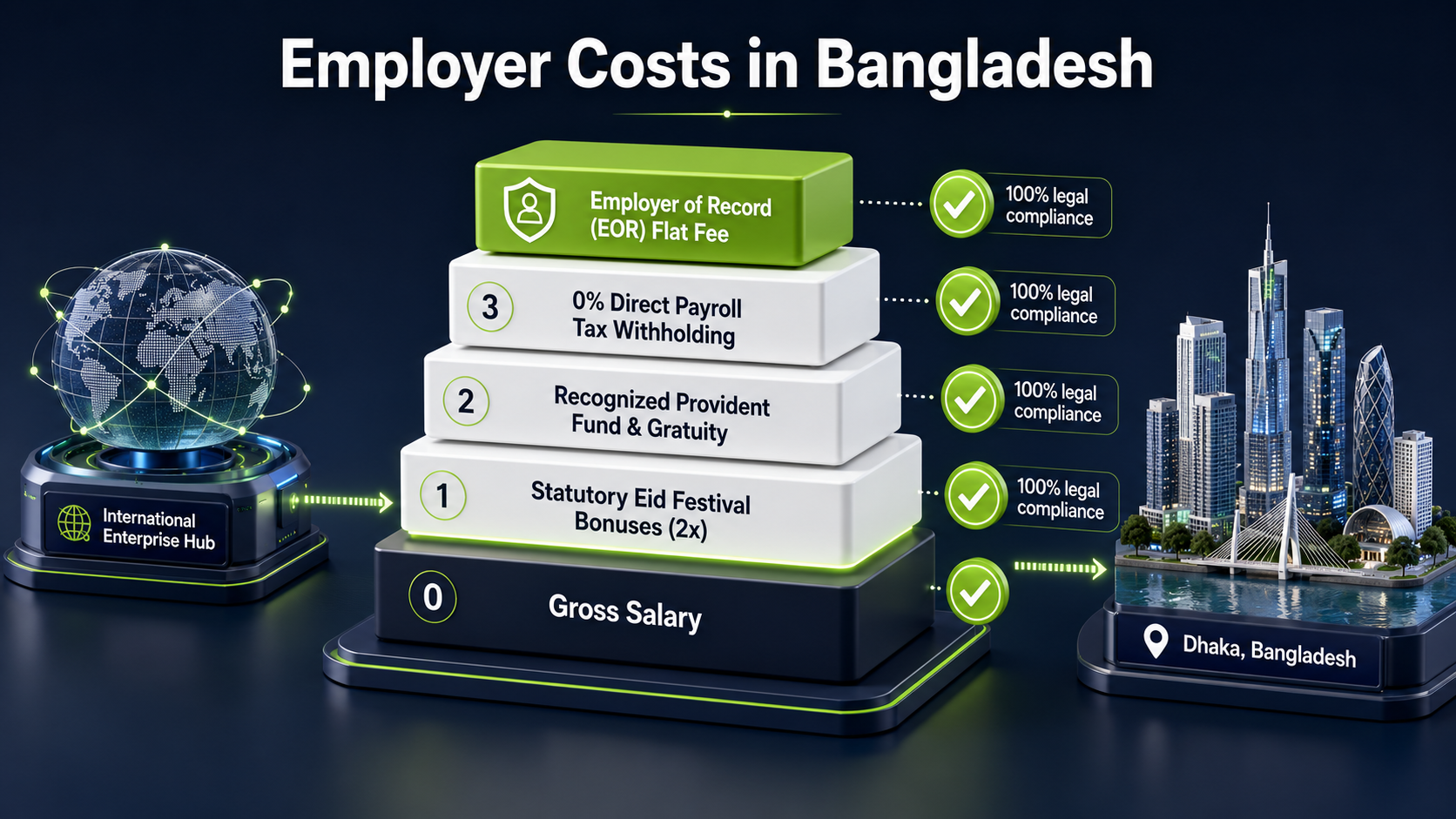
Hiring in Bangladesh can cost 18.3%–32.2% above gross salary when modeled statutory benefits and EOR fees are included, with 0% direct employer payroll tax. Using a 50% basic-salary model, benefit accruals add about 12.3% of gross, while EOR management typically adds $199–$299 per worker/month.
Expanding engineering and operational teams into Bangladesh provides international enterprises with access to top-tier technical talent at highly competitive wage baselines. However, calculating true cross-border employment outlays requires navigating statutory basic-wage splits, mandatory annual festival bonuses, and progressive tax withholding rules under the Bangladesh Labour Act 2006 (BLA) and the Income Tax Act 2023.
Rather than navigating complex local registrations with the Registrar of Joint Stock Companies and Firms (RJSC), global enterprises utilize an established Employer of Record infrastructure to automate statutory payroll, ensure 100% labor law compliance, and eliminate worker misclassification risks.
Key Takeaways for Foreign Employers
- Zero Direct Employer Payroll Tax: Bangladesh levies 0% employer-side corporate payroll or social security taxes; employers act solely as withholding agents for individual personal income tax (TDS).
- Dual Mandatory Festival Bonuses: Permanent employees completing 6+ months of service are legally entitled to two annual Eid bonuses under BLA 2006, each equaling one month’s basic wage (~8.33% to 10% gross payroll impact).
- Provident Fund (BLA Section 264, as amended): Private-sector employers must assess applicable provident-fund obligations, with PF expressly mandatory for establishments employing at least 100 permanent workers, subject to the statutory pension-scheme exception. Eligible permanent workers generally contribute 7%–8% of basic pay after one year of service, matched equally by the employer.
- Significant Entity Cost Avoidance: Partnering with a dedicated local EOR eliminates $15,000–$25,000+ in upfront RJSC incorporation costs and avoids mandatory 5% Workers’ Profit Participation Fund (WPPF) corporate transfers.
- Transparent Cost Structure: Real employer outlays range from $1,322/mo for a $1,000/mo junior hire to $5,915/mo for a $5,000/mo senior lead, with bank wire FX conversion spreads handled at pass-through cost.
What is the True Cost of Hiring an Employee in Bangladesh?
The true cost of employment in Bangladesh comprises contractual gross salary, mandatory statutory benefits, dual festival bonus accruals, and administrative compliance fees. Unlike Western payroll systems with heavy employer-side social security levies (e.g., FICA in the US or NIC in the UK), Bangladesh employer burdens are primarily driven by employee retirement reserves and cultural statutory bonuses.
Statutory compensation packages in Bangladesh maintain a strict division between Basic Salary (50% to 60% of gross) and allowable allowances (House Rent, Medical, Conveyance). Structuring these allowances properly is essential; employers should review our detailed guide on mandatory salary components in Bangladesh to ensure full compliance with sector wage minimums:
- Gross Base Compensation: The foundational salary agreed in the employment contract.
- Two Annual Festival Bonuses (BLR 2015 Rule 111(5)): Eligible workers receive two annual bonuses, each capped at one month’s basic wage.
- Retirement Provisioning (BLA 2006 Sec 264 / 27): Either monthly matching Recognized Provident Fund (RPF) contributions or terminal Gratuity accruals.
- Tax Withholding Administration (Income Tax Act 2023): Employer compliance for monthly Tax Deducted at Source (TDS) and annual Proof of Submission of Return (PSR) verification.
- EOR Compliance Management Fee: Flat monthly fee ($199–$299/worker) covering localized payroll disbursal, statutory filings, and legal indemnification.
- Foreign Exchange (FX) & Transfer Spreads: Commercial bank currency conversion spreads (typically 1.5%–2.5%) and international SWIFT transfer fees billed at direct pass-through cost.
What Mandatory Statutory Payroll Benefits Apply Under Bangladesh Law?
Mandatory statutory employee benefits are governed by the Bangladesh Labour Act 2006 (BLA) and the Bangladesh Labour Rules 2015. Employers must account for three primary benefit categories:
1. Dual Eid Festival Bonuses (Rule 111)
Under Bangladesh Labour Rules 2015 Rule 111(5), covered workers who have completed at least one year of continuous service are legally entitled to two festival bonuses per year. Each bonus may be up to one month’s basic wage. For non-Muslim staff, employers disburse festival bonuses during their respective major religious celebrations (e.g., Durga Puja, Christmas, or Buddha Purnima).
2. Recognized Provident Fund (RPF) vs. Statutory Gratuity
Under BLA Section 264, an RPF is mandatory if established by company service rules or demanded by three-fourths of permanent employees, requiring equal employer matching (typically 7% to 8% of basic pay).
If no RPF is operated, the employer is subject to statutory Gratuity under BLA Section 27 / Section 2(10), requiring 30 days of basic wages per completed year of continuous service upon employee separation after at least 1 year of tenure (increasing to 45 days per year for tenure exceeding 10 years).
3. Statutory Paid Leave & Leave Encashment
- Annual Earned Leave (BLA Sec 117): 1 day of paid leave for every 18 days worked (approx. 16–18 days annually; unspent leave is encashable upon separation).
- Paid Sick Leave (BLA Sec 116): 14 calendar days per year on full pay supported by a registered medical practitioner’s certificate.
- Casual Leave (BLA Sec 115): 10 calendar days per year for personal emergencies.
- Maternity Benefit (BLA Sec 46–48): 120 days of paid maternity benefit for eligible female workers with 6+ months of service.
How Does Bangladesh Withhold Employee Income Tax (TDS) Under the Income Tax Act 2023?
Bangladesh does not levy corporate social security or payroll taxes on employers. Instead, companies act strictly as withholding agents under the Income Tax Act 2023 (Act No. 12 of 2023), deducting personal income tax via Tax Deducted at Source (TDS) and remitting it monthly to the National Board of Revenue (NBR). For foreign entities managing cross-border teams, maintaining full statutory tax and payroll compliance in Bangladesh ensures official treasury challans are generated seamlessly without entity registration friction.
Proof of Submission of Return (PSR) Mandate: Under Section 264 of the Income Tax Act 2023, employees must furnish their annual tax return acknowledgment to employers. Without valid PSR documentation, employers are mandated to enforce higher statutory tax withholding rates.
Real Cost Breakdown: Monthly Outlay for $1,000, $2,500, and $5,000 Hires
To accurately budget cross-border compensation, foreign employers must apply standardized basic-salary baselines across statutory formulas.
Model Assumptions: Basic Salary structured at 50% of Gross Compensation; PF matching modeled at 8% of Basic; Dual Festival Bonus accrued monthly at 16.67% of Basic (2 months basic / 12); flat-fee EOR administration.
*Note on Payment Rails: Figures exclude client international wire charges and local commercial bank BDT foreign exchange conversion spreads (typically 1.5%–2.5%), which are billed separately as direct pass-through costs.
Commercial Matrix: Direct Local EOR vs. Global Aggregators vs. Local Entity
When entering the Bangladesh tech market, foreign executives evaluate three operational models: Global EOR Aggregators (e.g., Deel, Remote, Multiplier), Direct Local Employer of Record (EOR) services in Bangladesh, or incorporating a local RJSC subsidiary. Companies can review our comprehensive EOR vs. local entity setup cost comparison to evaluate the long-term capitalization and governance tradeoffs:
Case Study: Migrating 6 Software Engineers from Contractor Misclassification to Full Compliance
A Singapore-based B2B SaaS startup originally engaged six full-time remote engineers in Dhaka using standard direct contractor agreements.
The Operational Trigger
When two senior developers sought local mortgage approvals and Schengen travel visas, domestic financial institutions rejected their foreign contractor agreements due to the absence of registered BDT payslips and official National Board of Revenue (NBR) tax deduction certificates (Challans). Furthermore, the startup faced potential retroactive claims exceeding $32,000 for unpaid statutory Eid bonuses and misclassification liabilities under BLA 2006.
The EOR Migration Solution
Companies managing independent freelancers often utilize specialized contractor management in Bangladesh or transition core full-time talent onto an EOR. The startup partnered with eor.bd to regularize its workforce infrastructure:
- Compliant Contract Regularization: Transitioned all six engineers onto BLA 2006-compliant permanent employment contracts within 4 business days.
- Automated Bonus Accruals: Implemented a 1/12th monthly accrual model for dual Eid festival bonuses, protecting the parent entity from cash-flow compression during Eid months.
- TDS & PSR Regularization: Automated monthly NBR tax withholdings, issuing official salary certificates that enabled engineers to obtain loan approvals without audit friction.
- Direct IP Assignment: Executed tripartite IP assignment agreements assigning 100% of all software copyright and patent rights directly to the Singapore parent entity.
4-Step Onboarding Execution Blueprint
Onboarding remote engineers in Bangladesh through an Employer of Record is completed in four structured stages:
Candidate Data Collection
Collect National ID (NID), e-TIN certificate, educational credentials, and local BDT bank account information.
BLA Contract Execution
Execute localized employment agreements with compliant basic/allowance splits and direct IP assignment covenants.
NBR & Tax Registration
Register worker in the statutory payroll system, verify PSR compliance status, and calculate monthly progressive TDS.
First Payroll Run
Execute monthly BDT bank transfer, deposit NBR tax challans, and issue itemized payslips to employees.
Frequently Asked Questions (FAQs) for Foreign Employers
Calculate Your Exact Bangladesh Payroll Budget
Eliminate misclassification liabilities, automate dual Eid bonus accruals, and onboard verified remote talent in 3–5 business days.
Last reviewed: August 31, 2026
Author: Bangladesh Global Payroll & EOR Compliance Editorial Desk | Reviewed by Certified Labor Law Specialists
Disclaimer: This article provides general educational information and does not constitute formal legal or tax counsel. Verify current statutory requirements with relevant Bangladesh authorities or licensed local advisors.
3 comments on “Employer Costs in Bangladesh: Statutory Benefits, Taxes & EOR Fees Breakdown”