


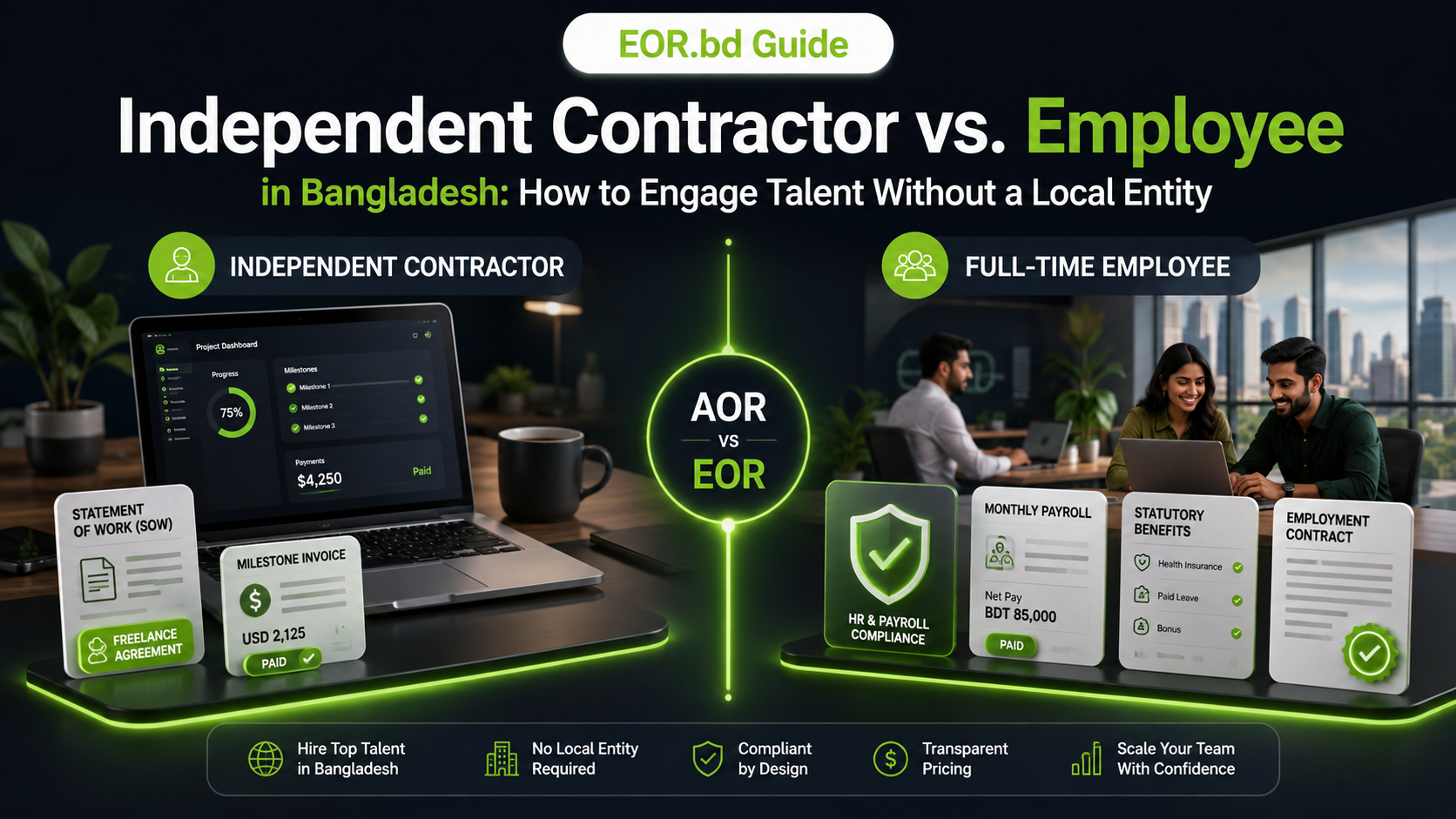
Foreign companies can engage talent in Bangladesh without establishing their own local employing entity, but the right route depends on whether the relationship is contracting or employment: AOR / Contractor Management for genuine independent contractors, or Employer of Record (EOR) for employees.
Foreign companies can generally engage talent in Bangladesh without establishing their own local employing entity, but the right route depends on whether the relationship is contracting or employment.
The key question is not which option looks cheaper or easier. It is what the actual working relationship requires. A contractor arrangement involves different responsibilities for contracts, invoices, payments, and ongoing administration than an employment relationship.
For a foreign company, that decision determines the operating route: AOR / Contractor Management for genuine independent-contractor relationships, or EOR for employees when the company does not have its own employing entity in Bangladesh.
This guide will help you compare both models, identify the questions that matter before classifying a Bangladesh-based worker, understand the risks of getting that classification wrong, and decide which no-entity route better fits the relationship.
Unsure whether your Bangladesh hire is a contractor or employee?
Talk to EOR.bd before onboarding or converting your Bangladesh hire.
Key Takeaways
- Foreign companies can engage talent in Bangladesh without establishing their own local employing entity, but the correct structure depends on the actual working relationship.
- A genuine independent contractor is typically managed through AOR / Contractor Management, while an employee is managed through EOR.
- The contract label alone is not enough. Control, independence, integration, continuity, and the real day-to-day arrangement matter when assessing worker status.
- Misclassification can create exposure around employment obligations, payroll and tax treatment, termination, documentation, and disputes.
- If a contractor relationship evolves into an employment-like role, the structure should be reassessed and may need to move from AOR to EOR.
- For foreign companies, the practical decision is not simply “contractor or employee?” but “which engagement model fits this relationship while allowing us to operate in Bangladesh without a local entity?”
What Is the Difference Between an Independent Contractor and an Employee in Bangladesh?
An independent contractor provides services under a commercial engagement and is generally expected to retain meaningful independence over how the agreed work is delivered. An employee works within an employment relationship, where the employer has greater direction over the role and assumes employment obligations such as payroll, applicable statutory benefits, leave, and compliant termination.
Independent Contractor vs. Employee: What Changes for a Foreign Company?
| Question | Independent Contractor | Employee |
|---|---|---|
| Nature of relationship | Commercial/service relationship | Employment relationship |
| Work structure | Usually centred on agreed services, projects, or deliverables | Usually centred on an ongoing role and assigned responsibilities |
| Operational independence | Greater independence is normally expected | Employer normally has greater direction over the role |
| Payment | Typically handled against contractor invoices or agreed service fees | Paid through payroll as salary/wages |
| Employment benefits | Not automatically treated as employee benefits merely because services are provided | Applicable employment entitlements must be administered |
| Documentation | Contractor agreement and often a Statement of Work (SOW) | Employment contract and payroll/HR records |
| Foreign-company management route | Contractor Management / Agent of Record (AOR) where appropriate | Employer of Record (EOR) when employment is required without a local employing entity |
AOR and EOR are service models, not statutory worker classifications. Worker status depends on the applicable Bangladesh Labour Act and the actual relationship.
Can a Foreign Company Engage an Independent Contractor in Bangladesh Without a Local Entity?
Generally, yes. A foreign company can engage a genuine independent contractor in Bangladesh without establishing its own local employing entity, subject to applicable tax, foreign-exchange, and regulatory requirements under Bangladesh Bank guidelines.
For a foreign company, there are two practical ways to manage that contractor relationship:
| Engagement Route | How It Works |
|---|---|
| Direct contractor engagement | The foreign company manages the contractor agreement, onboarding, invoices, payments, records, and ongoing administration itself. |
| AOR / Contractor Management | A third-party provider manages the operational contractor lifecycle on behalf of the foreign company. |
What Contractor Management Can Cover
Through EOR.bd’s Contractor Management service, foreign companies can centralize areas such as:
- contractor onboarding;
- independent contractor agreements;
- invoicing and payment coordination;
- contractor documentation and records;
- ongoing contractor administration;
- classification-risk support.
But Contractor and Employee Are Not Interchangeable
The no-local-entity advantage does not mean every worker should be classified as a contractor.
If the actual relationship is employment, the route changes:
| Worker Relationship | No-Entity Management Route |
|---|---|
| Genuine Independent Contractor | AOR / Contractor Management |
| Employee | Employer of Record (EOR) |
An Employer of Record in Bangladesh allows a foreign company to employ staff locally without establishing its own employing entity, while the EOR manages employment administration such as payroll, applicable tax withholding, statutory benefits, and HR compliance.
What the Foreign Company Actually Needs to Decide
Before choosing between AOR and EOR, the foreign company should look at how the person will actually work, not just what the contract is called.
- Is the individual delivering defined services or filling an ongoing role?
- How much control does the company exercise over the work?
- How integrated is the person into the company’s operations?
- Is the engagement project-based or continuing?
- Does the relationship function more like independent service provision or employment?
These practical characteristics matter because they determine the correct management route:
A genuine contractor relationship may fit AOR/Contractor Management, while an employment relationship is better aligned with EOR.
When Does an Independent Contractor Relationship Start Looking Like Employment in Bangladesh?
A contractor relationship may start to resemble employment when the individual loses meaningful independence and becomes integrated into the company’s regular workforce. The contract title alone is not decisive; foreign companies should assess how the relationship actually operates.
The Bangladesh Labour Act defines “worker” broadly, including qualifying persons engaged directly or through a contractor. Classification should therefore be checked against current law, including applicable statutory provisions, and the actual arrangement.
EOR.bd Contractor Classification Screening Framework for Bangladesh
These are practical screening factors, not a statutory legal test.
| Factor | More Contractor-Like | More Employee-Like |
|---|---|---|
| Work scope | Defined project or deliverable | Ongoing internal role |
| Control | Greater autonomy | Close to company direction |
| Schedule | Flexible | Company-set hours |
| Integration | External service provider | Embedded in internal team |
| Continuity | Project-based | Continuous responsibilities |
No single factor automatically determines status. The overall working relationship matters.
If the relationship remains genuinely independent, AOR/Contractor Management may be appropriate. If it functions as employment, the foreign company should consider an EOR when it does not have its own employing entity in Bangladesh.
What Happens If a Foreign Company Misclassifies an Employee as an Independent Contractor in Bangladesh?
Misclassification can create more than a contract problem. If a relationship is treated as independent contracting but is later regarded as employment, the foreign company may face exposure around employment entitlements, payroll and tax treatment, termination obligations, documentation, and potential disputes.
The Bangladesh Labour Act defines “worker” broadly, including qualifying persons engaged directly or through a contractor. The contract label alone should therefore not be treated as decisive under the current framework.
Key Risks for a Foreign Company
- Backdated employment obligations: a reclassified relationship may trigger questions around wages, leave, termination benefits, or other applicable employment entitlements.
- Payroll and tax corrections: Employee compensation and contractor payments may follow different tax or withholding treatment. Check the Income Tax Act, 2023 and current Withholding Tax Rules.
- Termination disputes: ending a contractor agreement may become more complicated if the individual can establish that the relationship functioned as employment.
- Compliance and documentation exposure: inconsistent contracts, payment records, supervision practices, or onboarding documents can make the company’s intended classification harder to defend.
AOR Does Not “Fix” a Misclassified Employee
An Agent of Record (AOR) is an administrative model for genuine independent-contractor relationships; it does not change the underlying legal character of the relationship.
If the working arrangement has moved into employment, the cleaner no-entity route is generally to reassess the structure and, where appropriate, move the individual to an Employer of Record (EOR) model.
Independent Contractor → AOR / Contractor Management
Employee → EOR
If the relationship is genuinely independent, EOR.bd’s Contractor Management service can support the AOR route; if it is employment, its Employer of Record in Bangladesh service provides the no-local-entity employment route.
AOR vs. EOR in Bangladesh: Which Model Should a Foreign Company Use?
The choice depends on the working relationship, not simply on which model is cheaper or faster. In EOR.bd’s service structure, AOR manages genuine contractors, while EOR supports local employment without the foreign company establishing its own employing entity.
| Decision Point | AOR / Contractor Management | EOR |
|---|---|---|
| Worker status | Independent contractor | Employee |
| Relationship | Commercial service engagement | Employment |
| Contract | Independent contractor agreement / SOW | Local employment contract |
| Payment | Contractor fees and invoices | Salary through payroll |
| Administration | Onboarding, contracts, invoicing, payments, contractor records | Payroll, tax withholding, statutory benefits, leave and employment administration |
| Best fit | Project-based or genuinely independent service relationships | Ongoing roles that function as employment |
| Local entity required? | Generally not for the contractor-management model | No—the EOR acts as the local employer |
When AOR Makes More Sense
AOR is the stronger fit when the individual remains genuinely independent, and the foreign company wants help managing the operational side of that relationship. Through EOR.bd’s Contractor Management service, the company can centralize contractor onboarding, agreements, invoicing, payments, and documentation instead of managing each contractor separately.
When EOR Makes More Sense
EOR becomes relevant when the role is structured as employment, but the foreign company does not want to establish its own Bangladesh entity. Through EOR.bd’s Employer of Record service, the employee can be locally employed while payroll, applicable tax withholding, statutory benefits, and employment administration are managed in Bangladesh.
For detailed calculations on employer line items, read Employer Costs in Bangladesh: Statutory Benefits, Taxes & EOR Fees Breakdown.
The practical rule is simple: do not choose AOR to avoid employment obligations, and do not use EOR when the relationship is genuinely independent. Choose the model that matches how the person actually works.
Can a Foreign Company Convert an Independent Contractor to an Employee in Bangladesh?
Yes. A foreign company can move an existing Bangladesh-based contractor into an employee relationship without establishing its own local entity by using an Employer of Record (EOR). In practice, this means replacing the contractor arrangement with a local employment structure, payroll, applicable tax withholding, statutory benefits, and employment administration.
Conversion becomes worth considering when the role has evolved beyond a defined independent service engagement—for example, when the individual becomes part of the ongoing team, takes on continuing responsibilities, or the company needs a level of direction and integration that is more consistent with employment. The decision should be based on the actual working relationship, not simply how long the contractor has worked with the company.
From AOR to EOR: What Changes?
| Before | Transition | After |
|---|---|---|
| Independent Contractor / AOR | Reassess the relationship and replace the contractor structure where employment is appropriate | Employee / EOR |
| Service agreement & invoices | Local employment onboarding | Employment contract & payroll |
| Contractor administration | Worker records and payroll setup | Salary, applicable tax and statutory employment administration |
EOR.bd supports this AOR-to-EOR transition: an independent contractor managed through Contractor Management can move to the Employer of Record in Bangladesh service when employment becomes the appropriate structure, while the foreign company continues operating without its own local employing entity.
For complete hiring setup steps, read How to Hire and Pay Employees in Bangladesh Without a Local Entity.
AOR or EOR in Bangladesh: 30-Second Decision Guide
Choose AOR for a genuine independent service relationship and EOR where local employment is required. Review control, integration, continuity, and how the work is actually structured before choosing.
| Ask This | AOR / Contractor Management | EOR |
|---|---|---|
| What is the relationship? | Independent service engagement | Employment |
| How is the work structured? | Project, scope, or deliverable-based | Ongoing role and responsibilities |
| How much independence exists? | Greater autonomy over delivery | Greater company direction and integration |
| How is the person paid? | Contractor fees/invoices | Salary through payroll |
| What does the foreign company need? | Contractor administration without managing everything internally | Local employment without establishing its own entity |
For foreign companies using EOR.bd, the distinction creates a clear path: Contractor Management/AOR supports genuine independent-contractor relationships, while Employer of Record (EOR) supports employees who need to be hired and managed locally without the foreign company establishing its own Bangladesh entity.
Frequently Asked Questions
Can a foreign company engage a contractor in Bangladesh without opening a local entity?
Can someone work full-time for one foreign company and still be an independent contractor?
How can a foreign company pay an independent contractor in Bangladesh?
When should a Bangladesh contractor be converted to an employee?
Can an AOR eliminate contractor misclassification risk?
Conclusion: Choose the Engagement Model That Matches the Relationship
Independent contractors and employees require different engagement models. For foreign companies operating without a local Bangladesh entity, the correct route should depend on how the working relationship actually functions—not simply on the contract title.
A genuine independent-contractor relationship can be managed through AOR/Contractor Management, while an employment relationship can be handled through EOR, covering local employment, payroll, statutory administration, and HR compliance.
As the role evolves, the engagement model should be reviewed. If an independent contractor gradually becomes part of the company’s ongoing workforce, moving from AOR to EOR may become the more appropriate structure.
Last reviewed: 2 September 2026
Written by: EOR BD Editorial Team
Reviewed by: Asma Sultana, Payroll and Employer of Record Specialist, EOR BD (18 years of payroll and employment-administration experience, with operational experience supporting Employer of Record services in Bangladesh).
This article is general information, not legal or tax advice. Verify current rules with the relevant Bangladesh authority or a licensed adviser.