


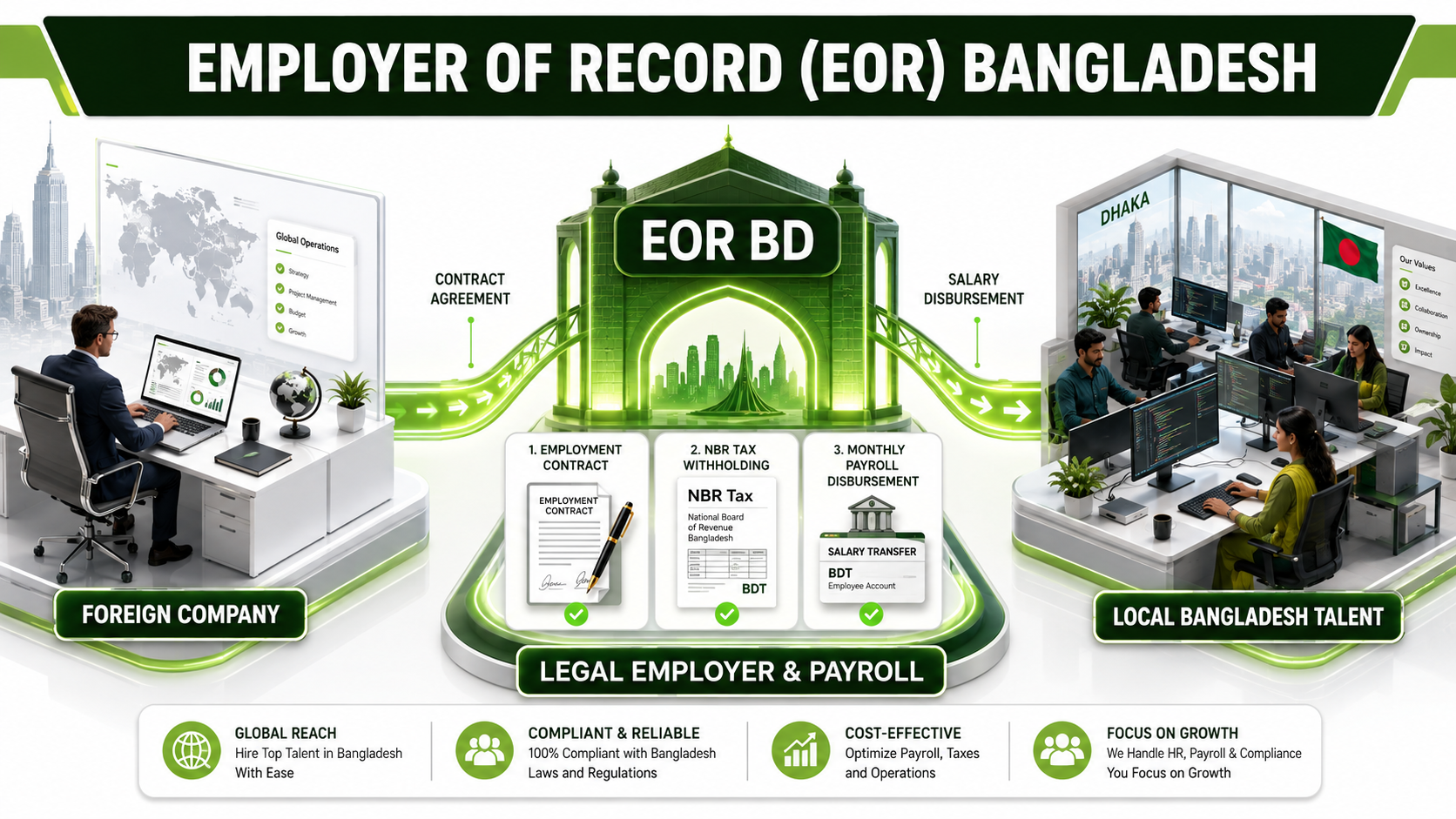
An Employer of Record in Bangladesh acts as the legally registered local employer for remote talent on behalf of an overseas company. The EOR administers employment contracts, statutory payroll, tax withholding under the Income Tax Act 2023, and compliance under the Bangladesh Labour Act 2006, while the foreign company retains day-to-day managerial direction over the employee’s work and business priorities.
An Employer of Record in Bangladesh can help a foreign company hire local employees without setting up its own Bangladesh legal entity. The EOR acts as the local legal employer for the agreed employment arrangement and can administer employment documentation, payroll, tax-withholding support, employee records, and agreed HR processes, while the foreign company retains day-to-day direction of the employee’s work.
This guide explains whether EOR fits your Bangladesh hiring plan, what to budget for, how onboarding works, and what to check before selecting a provider.
Planning to hire in Bangladesh?
Request an itemized EOR employment-cost estimate based on the role, gross salary, benefits, start date, and expected headcount.
Key Takeaways
- Hire without immediate entity setup: An Employer of Record can be an option if you want to employ people in Bangladesh before opening your own local company.
- Keep control of the work: Your company manages the employee’s role, priorities, performance, and daily work. The EOR manages the agreed local employment administration.
- Understand the real cost before hiring: Your budget is more than the employee’s salary. This guide explains the cost areas to review, including employer obligations, benefits, payroll administration, and EOR fees.
- Assess EOR first for an initial Bangladesh hire: EOR is often the practical starting point when you need to employ a Bangladesh-based worker before your long-term entity plan is settled.
- Know what to check before choosing a provider: You will learn what to ask about the local employing entity, service scope, payroll process, employment documents, fees, employee support, and future entity-transition options.
What Is an Employer of Record in Bangladesh?
An Employer of Record (EOR) in Bangladesh is a local organization that becomes the legal employer for a worker on behalf of a foreign company. The EOR administers the agreed employment arrangement, including employment documentation, payroll administration, employee records, tax-withholding support, and routine HR processes, while the foreign company continues to direct the employee’s day-to-day work, role, priorities, systems, and performance.
An EOR can be relevant when a foreign company wants to employ a Bangladesh-based worker or initial team without first establishing its own Bangladesh legal entity. The model gives the foreign company a structured way to begin local hiring while it evaluates the scale, duration, and long-term direction of its Bangladesh operation.
For foreign companies, the practical value is having a Bangladesh-based employment and payroll administration route while the company evaluates its long-term local operating plan.
The Three-Party Employment Structure
An EOR arrangement normally involves the foreign client company, the Bangladesh-based employee, and the local Employer of Record.
Control Remains With the Foreign Company
Your company continues to manage the employee’s daily work, priorities, reporting line, performance, systems, and business outcomes. The EOR manages the agreed local employment-administration layer.
Employer of Record Lets Foreign Companies Hire Before Entity Formation
An Employer of Record is often the practical first step when a foreign company needs to hire in Bangladesh before it is ready to establish and operate its own local entity. EOR lets your company employ a Bangladesh-based worker through an agreed local employment arrangement while your managers retain control of the role, work priorities, performance, and business outcomes.
EOR is particularly useful when you need to:
- Hire a first employee or small initial team in Bangladesh.
- Begin recruitment while your long-term entity and market-entry plan is still developing.
- Avoid building immediate local payroll, HR, and employer-administration capability.
- Keep open the option to establish a Bangladesh entity later if the operation grows.
Decision point: Use EOR when hiring is the immediate priority; evaluate entity formation when your Bangladesh operation requires a sustained local commercial and employer structure.
Plan for a Future Entity Only if Growth Requires It
EOR does not need to be permanent. If your Bangladesh team grows into a long-term operation, you can later assess moving employees to your own Bangladesh entity. Before onboarding, ask the provider whether it can explain the proposed employee-transfer process, payroll transition, and any applicable fees.
For the detailed comparison, read EOR vs. Entity Setup in Bangladesh: Cost, Compliance, and Timeline Compared.
EOR Keeps Your Company in Control of the Work
An EOR manages the agreed local employment administration, while your company remains responsible for the employee’s role, work direction, performance, systems, and business outcomes. The arrangement lets you retain operational control without immediately becoming the local employer through your own Bangladesh entity.
Decision point: Confirm the exact service scope in writing before making an offer. Your EOR agreement should clearly state what the provider manages and what remains with your company.
What Does It Cost to Employ Through an EOR in Bangladesh?
Employing through an EOR in Bangladesh costs more than the advertised monthly EOR fee. Before approving a hire, foreign companies should ask for one written estimate that separates employee pay, employer-related costs, and the EOR’s service and payment charges.
Buyer checkpoint: Compare providers using the same employee salary, benefits, start date, headcount, and payment currency. A low headline fee can be misleading if other charges are not shown separately.
Ask the provider one question before you proceed: “Can you provide a complete written cost estimate showing every recurring, one-time, and event-based charge for this Bangladesh hire?”
Request an itemized Bangladesh EOR cost estimate before you make an offer.
Bangladesh EOR Onboarding Requires Clear Hiring Inputs
EOR onboarding in Bangladesh starts when the foreign company provides complete hiring information and the employee provides the documents needed for the agreed employment and payroll setup. A well-prepared onboarding process helps the EOR issue appropriate employment documents, configure payroll, and coordinate the employee’s start without avoidable delays.
The EOR Onboarding Workflow
- Confirm the hire: Share the job title, candidate, gross salary, benefits, work arrangement, reporting line, target start date, and expected headcount.
- Review the employment setup: Confirm that EOR is the appropriate engagement route and agree the employment-administration scope, commercial terms, and payroll funding process.
- Prepare employment documents: The EOR prepares the agreed employment documentation; the foreign company reviews the commercial terms, and the employee completes required acceptance steps.
- Collect employee information: The employee provides required identity, tax, bank, and other onboarding information relevant to the Bangladesh employment arrangement.
- Set up payroll and approvals: The EOR configures payroll details, salary-payment workflow, benefits or allowances, payroll approvals, and the first payroll schedule.
- Begin employment and ongoing support: The employee starts work for the foreign company while the EOR administers the agreed payroll and employment-support process.
How EOR BD Supports Foreign Companies Hiring in Bangladesh
EOR BD supports foreign companies that need a practical Bangladesh employment route before establishing their own local entity. Under an agreed service scope, EOR BD coordinates local employment documentation, payroll administration, tax-withholding support, and employee records. Before onboarding, EOR BD can discuss the proposed service scope and prepare an employment-cost estimate based on the role, compensation plan, hiring timeline, and expected team size.
For the detailed operational guide, read How to Hire and Pay Employees in Bangladesh Without a Local Entity.
Payroll, Salary, and Benefits Need Early Planning
A foreign company should agree the employee’s compensation package before EOR onboarding begins. The EOR can administer the agreed payroll process, including salary payment, tax-withholding support, records, and benefits administration, but the foreign company must first define what it is offering and approve the payroll inputs.
Before making an offer, confirm:
- Salary and benefits: Gross salary, agreed benefits, allowances, and variable pay.
- Payroll approvals: Who approves monthly payroll funding and compensation changes.
- Employment changes: How promotions, leave, role changes, and offboarding instructions will be communicated.
Bangladesh payroll arrangements may involve tax-withholding administration and related documentation. The National Board of Revenue (NBR) publishes current income-tax rules, forms, and withholding-tax materials; confirm the applicable treatment for the employee and payment arrangement before payroll is finalised: NBR income-tax rules | NBR income-tax forms and withholding materials.
For detailed guidance, read Mandatory Salary Components for Foreign Employers: Bangladesh EOR Guide.
For detailed Bangladesh employment-cost planning, read Employer Costs in Bangladesh: Statutory Benefits, Taxes & EOR Fees Breakdown.
Work Authorization for Foreign Nationals
EOR employment does not automatically provide a foreign national with the right to work in Bangladesh. If the planned hire is not a Bangladesh national, review the applicable visa and work-permit route before confirming a start date. BIDA publishes work-permit and visa-related guidance for foreign workers, including current process information through its One Stop Service (OSS) system: BIDA work-permit guidance; BIDA OSS security-clearance update.
Read our comprehensive guide: Work Permits for Foreign Employees in Bangladesh: Employer’s Guide.
How Foreign Companies Should Evaluate an EOR Provider in Bangladesh
The right EOR provider should give your company a clear local employment route, transparent costs, and dependable payroll and employee support. Before signing, focus on whether the provider can explain who employs the worker, what the service covers, how money moves, and who supports your team when something changes.
Buyer checkpoint: Do not choose an EOR only because it offers the lowest monthly fee. Choose the provider that gives you the clearest written scope, total-cost estimate, Bangladesh delivery model, and employee-transition plan.
Next action: Request a written Bangladesh EOR proposal that confirms the local employing entity, service scope, payroll process, complete cost estimate, and future employee-transfer options.
Bangladesh EOR Quote Readiness Check
A useful Bangladesh EOR quote starts with a clear hiring brief. When a foreign company shares the role, compensation, start date, and expected team plan, the EOR can prepare a more realistic cost estimate and onboarding plan instead of giving a generic headline price.
Before requesting an EOR quote, prepare these four details:
- The role and work location
- The gross salary and planned benefits
- The target start date and expected headcount
- Whether your Bangladesh team may later move to your own entity
Request an Itemized Bangladesh EOR Quote
Share your hiring brief to receive a written estimate based on your planned role, salary, start date, and team size.
Frequently Asked Questions About EOR in Bangladesh
How long does EOR onboarding in Bangladesh take?
Can we request an EOR cost estimate before choosing a candidate?
What happens if we later open a Bangladesh entity?
Does an EOR arrangement automatically provide work permission for foreign nationals?
Make the Right Bangladesh Hiring Decision Before You Hire
An Employer of Record can be a practical way for foreign companies to hire in Bangladesh before establishing their own local entity. The right next step is to confirm whether EOR fits your current hiring plan, understand the total employment cost, and obtain a written service scope from a credible local provider.
Share your role, salary range, benefits plan, target start date, and expected headcount. EOR BD can prepare a written estimate for your Bangladesh hiring plan.
Last reviewed: 2 September 2026
Written by: EOR BD Editorial Team
Reviewed by: Asma Sultana, Payroll and Employer of Record Specialist, EOR BD (18 years of payroll and employment-administration experience, with operational experience supporting Employer of Record services in Bangladesh).
This article is general information, not legal or tax advice. Verify current rules with the relevant Bangladesh authority or a licensed adviser.